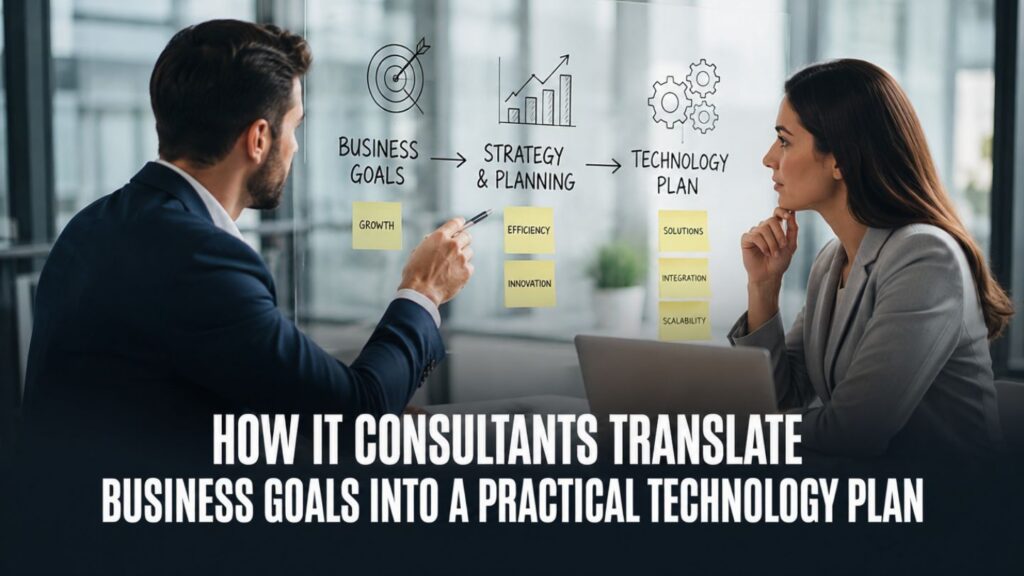
Every business has strategic goals – grow revenue, serve customers better, expand into new markets, reduce operational costs. But turning those ambitions into the right technology investments is where most organizations stall. The gap between business strategy and technology execution costs companies real money: a BCG survey found that nearly half of organizations report over 30% of their tech projects arrive late or over budget, often because business objectives and IT initiatives were never properly aligned.
IT consultants exist to close that gap. They translate high-level business goals into a structured, prioritized technology roadmap – one that connects every dollar spent on IT systems to measurable business value. For businesses across Metro Atlanta and nationwide, strategic IT planning is no longer optional. With 66% of CEOs believing digital transformation is necessary for survival, the companies that treat technology as a strategic asset rather than just a support function are the ones pulling ahead.
This post walks through the exact process IT strategy consultants use to bridge business objectives with actionable technology plans – from discovery and assessment through roadmap creation, implementation, and continuous improvement.
Key Takeaways
- IT consultants begin by conducting thorough business assessments to understand strategic objectives and operational challenges before recommending any technology solutions.
- Technology roadmaps emerge from a disciplined gap analysis between current capabilities and future business requirements.
- Successful translation requires prioritizing initiatives based on business impact, budget constraints, and implementation feasibility – not just technical appeal.
- Ongoing monitoring and optimization ensure technology investments continue supporting evolving business goals and deliver measurable financial benefits.
- Expert guidance helps avoid costly mistakes and ensures technology becomes a growth engine rather than just a cost center.
Understanding Business Objectives and Current Technology State
The first step isn’t about technology at all – it’s about the business. Consultants help define business objectives by interviewing key stakeholders across the organization: C-suite executives, department heads in sales, operations, finance, and HR, and often front-line employees. The goal is to surface the real strategic priorities – whether that’s reducing time-to-invoice by 50%, scaling to multiple locations, entering new markets, or strengthening security and compliance. This discovery process also gives leaders a clearer understanding of how to create an effective business IT strategy that connects operational needs, available resources, and long-term objectives.
This discovery process also maps existing business processes end-to-end. How does a customer order move from first contact through fulfillment? Where do manual handoffs slow things down? Where do communication silos between IT departments and business units create blind spots? By documenting how work actually flows – not how leaders assume it flows – consultants identify where technology currently supports or hinders broader business objectives.
Financial constraints and timeline expectations get equal attention during this phase. Without understanding budget ceilings, cash flow patterns, and expected ROI horizons, any technology strategy risks being overambitious or disconnected from reality. SMBs in particular face tight budgets: research shows that many spend roughly 66% of their IT budget maintaining existing systems, leaving only about 34% for new initiatives. For the smallest firms, that number drops to approximately 25%.
Common business goals that emerge during discovery include improving customer satisfaction through unified CRM and analytics, increasing operational efficiency through automation and streamlining processes, expanding market reach via cloud-based solutions and digital channels, and ensuring regulatory compliance through stronger security postures. Each of these goals will eventually need to be mapped to specific technology initiatives – but only after the current state is fully understood.
Conducting Comprehensive Technology Assessment

With business goals defined, consultants assess current IT infrastructure through a systematic evaluation. This means inventorying all hardware, software, networking equipment, data systems, integrations, vendor contracts, and licenses – then classifying each by criticality, usage, cost, age, and scalability.
Consultants evaluate current technology, identifying gaps in performance, security, and scalability. They look for performance bottlenecks – slow database queries, server outages, bandwidth limitations – that create operational drag. They conduct a thorough review of the existing IT environment to identify strengths and weaknesses across every layer of infrastructure.
Cybersecurity consulting begins with an IT risk assessment. The security posture assessment covers identity and access management, endpoint protection, patching cadence, configuration management, data encryption, and policy enforcement. Consultants recommend implementing Multi-Factor Authentication for security and audit compliance obligations such as HIPAA or PCI requirements. Robust cybersecurity strategies ensure compliance with industry regulations and reduce exposure to increasingly sophisticated threats.
Equally important is identifying redundancy and waste. Outdated systems, duplicate applications, underutilized licenses, shadow IT, and vendor sprawl all drain budgets without delivering business value. Technical debt – the accumulated cost of maintaining aging systems that are difficult or risky to update – is another critical finding. A US study estimated the cost of poor software quality and technical debt at hundreds of billions of dollars annually, underscoring why this analysis matters.
The assessment also examines IT spending patterns: CapEx versus OpEx breakdowns, cost per user, and the ratio of maintenance spending versus innovation spending. According to McKinsey, top-performing organizations – “deliberate modernizers” – keep their maintenance costs at least 20% lower than peers, freeing up capital for cloud, automation, and artificial intelligence.
Creating the Strategic Technology Roadmap
With the business assessment and technology evaluation complete, consultants perform gap analysis – the structured comparison of current technical capabilities against future business requirements. If the business wants to expand internationally but the current infrastructure doesn’t support data residency requirements or global availability, that’s a capability gap. If customer satisfaction scores are declining but there’s no unified CRM or analytics platform, that’s another gap. Tools like SWOT analysis, capability maturity models, and business process heat maps help visualize where the most critical disconnects exist.
Consultants develop a prioritized technology roadmap that connects initiatives to business value. They use frameworks like impact-versus-effort matrices to rank every potential initiative. High-impact, low-effort projects become quick wins. Foundation work – longer-term investments in infrastructure, security, or architecture – gets scheduled strategically so it doesn’t compete with immediate needs for resources or budget. For companies preparing to expand, understanding how IT consulting helps Atlanta firms plan for growth can make it easier to prioritize scalable systems, budgets, and technology investments.
The resulting IT roadmap is a phased implementation plan, typically spanning 12 to 36 months. Each phase includes specific technology initiatives, dependencies between projects, resource requirements, budget allocations, milestones, and success metrics tied to key performance indicators. A well-defined roadmap includes timelines and expected outcomes so business leaders can track progress and hold teams accountable.
Common initiatives within these roadmaps include cloud migration to improve scalability and reduce infrastructure costs, zero-trust cybersecurity implementations, workflow automation to reduce manual effort, integration of disparate systems into a single source of truth, and modernizing legacy systems that create ongoing maintenance burdens. Consultants help organizations adopt cloud solutions for improved agility while ensuring each initiative directly ties to defined strategic goals.
The alignment cycle consists of business goals, technology assessment, capability gaps, strategic roadmap, execution, and measurement – a continuous loop rather than a one-time exercise. Effective digital transformation requires a clear technology roadmap that balances quick wins delivering immediate cost savings with long-term strategic investments that support business growth over years.
Common Mistakes to Avoid in Technology Planning
Choosing technology solutions before understanding business requirements. This is the most frequent and most expensive mistake. When business leaders buy software or hardware based on vendor demos or industry hype – without first defining the problem – mismatches are inevitable. Aligning technology initiatives to business priorities must come first.
Implementing too many changes simultaneously without proper change management. Overloading the organization with parallel projects strains resources and reduces quality across every initiative. Employees can only absorb so much disruption at once. Underestimating how much training, communication, and support people need during transitions is a consistent source of project failure.
Focusing only on immediate needs without considering future scalability. Plans that don’t account for growth, regulatory changes, or technology end-of-life create problems 18 months later. Scalability in cloud computing and infrastructure architecture decisions made today directly affects whether the business can adapt tomorrow.
Inadequate stakeholder involvement leading to poor user adoption. When only the IT department or a single executive defines the plan, the resulting system often doesn’t match how real users work. Executive sponsors and cross-functional input are critical to adoption.
Underestimating the total cost of ownership. Projects that ignore hidden costs – support, maintenance, training, integration, decommissioning of old systems – frequently overrun budgets. IT consultants focus on creating governance frameworks for technology investments specifically to prevent this kind of scope and cost creep.
Implementation and Ongoing Optimization
A strategic technology roadmap is only as good as its execution. Consultants oversee the implementation of technology solutions while ensuring organizational adoption. This means developing detailed project plans with specific milestones, assigning ownership for each initiative, identifying executive sponsors, and building risk mitigation plans for predictable obstacles. At this stage, business leaders may also need to compare IT consulting and in-house IT teams to determine which model offers the right balance of daily support, specialized expertise, and strategic oversight.
Change management is where many digital transformation efforts succeed or fail. IT consulting enhances operational efficiency through streamlined processes – but only if the people using those processes adopt the new tools and workflows. Communication plans, structured training programs, user feedback channels, and adoption metrics are essential components. Engaging IT consultants improves customer experience through technology enhancements, but that improvement only materializes when employees are confident using the new systems.
Consultants help organizations measure success using business-focused key performance indicators rather than purely technical metrics. Revenue growth, margin improvement, customer satisfaction scores, employee productivity, and operational costs reduction all matter more than server uptime alone – though uptime matters too. Dashboards and scorecards track progress against the established business metrics, giving business leaders visibility into whether their IT investments are delivering.
Digital transformation integrates digital technologies into business processes across the entire organization, and that integration never truly ends. As business objectives evolve, market conditions shift, or emerging technologies create new opportunities, the technology roadmap adapts. Consultants provide continuous optimization recommendations – deprioritizing low-value initiatives, capitalizing on new vendor capabilities, responding to regulatory changes, or leveraging emerging technologies like artificial intelligence and machine learning.
Regular technology reviews – quarterly or at minimum semi-annually – ensure continued alignment between the IT strategic plan and evolving business priorities. IT strategy consulting increases organizational agility and flexibility precisely because it builds this review-and-adapt rhythm into how the organization operates. Consultants provide better risk management and security for businesses through ongoing assessment rather than one-time audits.
This continuous improvement cycle is what separates companies that achieve sustainable growth through technology from those that simply spend money on IT. Strategic IT planning transforms technology into a growth engine rather than a line item that leadership struggles to justify.
Turning Strategy Into Long-Term Business Growth

Successful technology planning is about more than selecting new tools. It requires a clear understanding of business priorities, a realistic assessment of current systems, and a structured roadmap that keeps technology aligned with long-term goals. When every IT decision supports measurable business outcomes, organizations are better positioned to improve efficiency, strengthen resilience, and adapt confidently as their needs evolve.
JETT Business Technology helps businesses across Atlanta and nationwide align technology with long-term success through expert IT consulting in Atlanta and comprehensive technology solutions. From IT installation and support and cloud services to security and backup and disaster recovery, our team delivers tailored solutions that support your business wherever you operate. If you are ready to build a technology strategy that supports your goals today and into the future, contact us to learn how we can help.
Frequently Asked Questions
How long does it typically take to develop a comprehensive technology roadmap?
For most SMBs, developing a comprehensive technology roadmap takes 8 to 12 weeks. Larger or more complex environments may require 3 to 6 months, depending on the number of systems involved, the depth of assessment required, and stakeholder availability. The timeline also depends on how clearly business objectives have been defined before the process begins.
What’s the difference between tactical IT support and strategic technology consulting?
Tactical IT support focuses on day-to-day operations – helpdesk tickets, break-fix maintenance, and keeping systems running. Strategic consulting is forward-looking: it defines what your technology environment should become, how it ties to business goals, and creates a phased plan for modernization, risk management, and investment. One keeps the lights on; the other determines which lights to build.
How do IT consultants ensure technology recommendations fit within budget constraints?
Consultants use total cost of ownership models, prioritize high-impact and low-cost quick wins early in the roadmap, and phase larger investments across budget cycles. They align recommendations with cash flow patterns and capital recovery expectations. Some organizations also benefit from fractional or virtual chief information officer arrangements that spread strategic consulting costs over time.
What role do employees play in the technology planning and implementation process?
Employees are critical throughout. During planning, stakeholder interviews surface pain points and workflow realities that leadership may not see. During implementation, employees shape requirements, test usability, and provide frontline feedback. Their involvement in training and change management directly determines adoption rates. Early engagement consistently improves buy-in and reduces resistance.
How often should businesses update their technology roadmaps to stay aligned with changing goals?
At a minimum, annually, though many organizations benefit from quarterly reviews. Business priorities shift, budgets change, vendors introduce new capabilities, regulations evolve, and emerging trends like AI create new opportunities. Regular reviews ensure the roadmap stays relevant and that resources aren’t being directed toward initiatives that no longer align with strategic objectives.
What are the key signs that a business needs strategic technology planning rather than just IT maintenance?
Warning signs include frequent firefighting and unplanned outages, rising operational costs without corresponding productivity gains, recurring security incidents, difficulty scaling operations, proliferation of shadow IT, duplicate or obsolete systems, inability to quantify the ROI of IT spend, and leadership uncertainty about what IT does or should do. If any of these sound familiar, the business has outgrown a maintenance-only approach and needs a deliberate IT strategy.