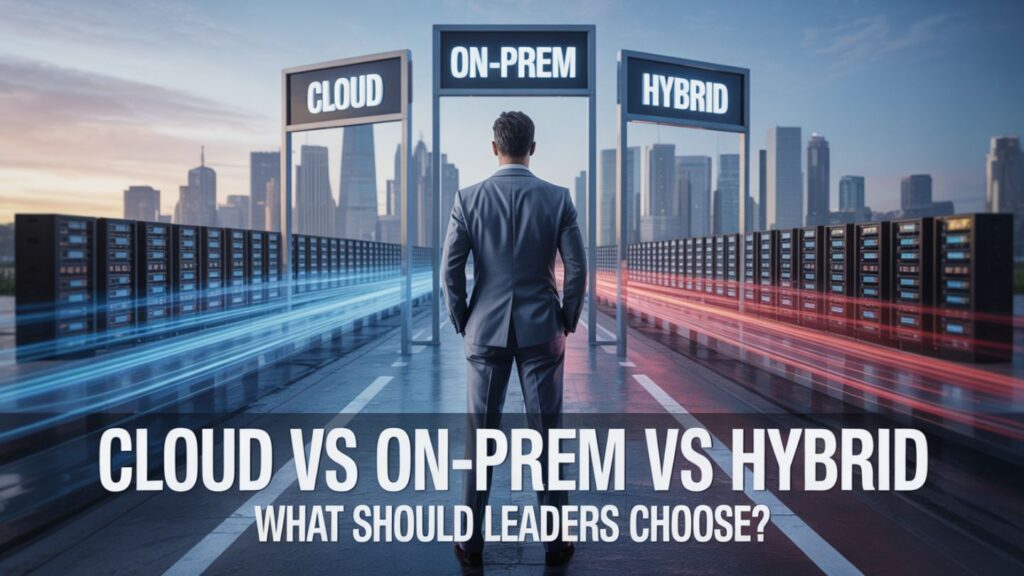
Choosing between cloud, on-prem, or hybrid IT infrastructure? This blog on Cloud vs On Prem vs Hybrid Guide for IT Business Leaders covers the pros and cons to help you decide based on cost, security, and scalability.
Key Takeaways
- Cloud computing models (public, private, and hybrid) each offer distinct advantages and challenges, impacting their suitability for different organizational needs.
- On-premise infrastructure provides organizations with complete control and security but comes with high upfront costs and limited scalability compared to cloud solutions.
- A hybrid cloud strategy combines public and private cloud benefits, optimizing cost management and flexibility, but necessitates careful planning and management to ensure effective integration.
Understanding Cloud Computing Models
Cloud computing is an application-based software applications infrastructure that uses the internet to provide on-demand cloud computing services. Understanding the different cloud computing models, including the cloud computing model of public cloud, private cloud, and hybrid cloud, is essential, as each offers unique benefits and challenges.
The public cloud offers shared resources, the private cloud provides dedicated infrastructure, and the hybrid cloud combines both for enhanced flexibility. Yet, many organizations are often confused about what each model entails.
Public Cloud
Public cloud computing involves providing computing resources via a public network by a service provider. It offers unmatched scalability and cost savings due to the pay-as-you-use model, making it a popular choice for businesses with fluctuating computing power workloads. Public cloud providers play a significant role in this ecosystem.
Public clouds are accessible to any internet user, providing efficiency and minimal waste of resources. This model is ideal for organizations looking to scale quickly without the need for significant upfront investments from a cloud provider, leveraging cloud based infrastructure.
Private Cloud
A private cloud is a dedicated computing resource provided for a single customer, offering greater control over security and resource customization. Customization options include firewalls, VPNs, and tailored security measures, making it suitable for organizations with stringent regulatory requirements.
Private clouds can be hosted on-premises, in offsite data centers, through cloud service provider infrastructure, or on physical servers, allowing businesses to choose their data location and jurisdiction in an on premise data center.
Hybrid Cloud
A hybrid cloud approach allows organizations to leverage both public and private cloud resources to enhance performance and maintain data security. It blends public and private cloud capabilities, enabling businesses to optimize workload placement according to specific needs.
Hybrid clouds offer a combination of private cloud security and public cloud usability, addressing fluctuating workloads by scaling on-premise infrastructure to the public cloud for overflow. However, managing hybrid cloud infrastructure environments can be complex and requires precise integration.
Evaluating On-Premise Solutions
On-premise infrastructures are managed directly by the organization, providing complete control over performance and security. This model requires significant upfront investments in hardware and setup costs but allows businesses to tailor their IT environment to specific needs, including on premises solutions, on premises infrastructure, own infrastructure, on premise software, and an on premises environment.
The advantages and challenges of on-premise solutions significantly influence IT infrastructure decisions, making it essential to weigh these factors carefully.
Benefits of On-Premise Infrastructure
On-premise setups offer several benefits:
- Facilitate direct control over sensitive data on premise, enhancing compliance with various regulations.
- Provide a high level of security, ensuring that critical assets are protected.
- Allow for customization tailored to specific business needs.
- Leverage existing infrastructure and extend capabilities to the cloud as needed.
Cloud computing plays a vital role in driving business growth by providing scalability, cost-efficiency, and flexibility. It enables businesses to streamline operations, improve collaboration, and adapt to changing demands. Understanding the benefits of cloud computing for business growth can help organizations unlock their full potential in a competitive market.
Read more: Exploring the Landscape of Cloud Computing
Challenges of On-Premise Infrastructure
Maintaining on-premise infrastructure entails:
- High significant upfront costs due to hardware and software purchases.
- Continuous investment in resources and personnel for maintenance, which can be challenging.
- Difficult scalability, often necessitating additional hardware investment to meet growing demands.
This makes on-premise infrastructure less flexible compared to cloud solutions.
Comparing Cloud vs On-Prem vs Hybrid Solutions

Choosing between cloud, on-premise, or hybrid solutions should be based on specific business needs, including cost, security, and scalability. Cloud solutions are known for cost-effectiveness, scalability, and flexibility, while hybrid solutions combine cloud and on-premise resources, offering enhanced flexibility and control.
The complexity of choices and the number of vendors/providers can significantly influence the decision-making process, making it essential to consult with experts to understand unique operational needs. Over 77% of business and IT professionals have embraced hybrid cloud strategies to enhance flexibility and drive growth.
Cost Considerations
Evaluating the total cost of ownership requires examining both direct expenses, like hardware and software, and indirect costs, such as personnel training. Cloud computing eliminates costly upfront fees and reduces the complexity of maintaining infrastructure, leading to significant cost savings.
A hybrid cloud strategy offers the flexibility to allocate workloads optimally between cloud and on-premises, contributing to effective cost management. Managed IT services can also help reduce cloud spending through strategic resource optimization.
Scalability and Flexibility
Cloud solutions offer scalability benefits such as:
- Quickly scaling resources to meet changing demands
- Allowing businesses to pay only for what they use
- Being particularly beneficial for businesses with fluctuating workloads, especially through cloud bursting and a cloud solution, provided by various cloud vendors.
- On-premise systems, however, require purchasing additional hardware for scalability, which can be inefficient.
A hybrid cloud offers flexibility by allowing businesses to choose the optimal service for each application and move workloads between cloud and on-premise. Implementing automation and orchestration tools is crucial for effectively managing resources in a hybrid environment.
Security and Compliance
Private clouds provide enhanced security and compliance tailored to specific needs, making them ideal for organizations with strict regulatory standards. Hybrid cloud environments require comprehensive robust security measures, including encryption and protocols for secure data transfer, ensuring data privacy and network security through virtual private networks.
Large enterprises benefit from hybrid cloud architectures, allowing them to securely store sensitive data on-premises while leveraging public cloud services for application accessibility. However, sharing data with third-party vendors in SaaS services poses significant risks of data breaches.
Selecting the Right Solution for Your Business Needs
The decision on the suitable model, cloud, on-premise, or hybrid, hinges on an organization’s specific requirements, budget, and security concerns. It is crucial to assess existing infrastructure, costs, regulatory issues, and compliance. This alignment will help ensure your data control management strategy meets your data storage needs and business goals.
This section will guide you through the process of making an informed decision that supports your business needs.
Assessing Current Infrastructure
Evaluating existing infrastructure and physical infrastructure involves looking at hardware longevity, compatibility with upcoming technologies, and team skill levels. Understanding the lifespan of existing hardware and its compatibility with new technologies is essential when assessing current infrastructure.
This evaluation should also consider recent investments in on-prem hardware and whether they affect the move to cloud solutions.
Identifying Key Requirements
Identifying critical factors such as performance, compliance, and growth expectations is key for informed IT infrastructure decisions. Companies must define their performance, compliance, and scalability needs before establishing a hybrid cloud environment.
This clarity will ensure that the chosen solution aligns with regulatory requirements and business objectives.
Planning for Future Growth
Infrastructure choices should be informed by the current position and future scalability of the business. These choices should account for how well they can adapt to future technological advancements and changing business objectives.
Organizations need to ensure that their infrastructure decisions can evolve in line with long-term business growth and emerging technologies.
Implementing Hybrid Cloud Solutions

Implementing hybrid cloud solutions involves strategic planning and a thorough understanding of both public and private cloud resources. Managed IT services play a crucial role by providing proactive support for cloud and hybrid environments, helping organizations manage their IT infrastructure efficiently.
This section will guide you through the steps of building a hybrid cloud strategy and managing hybrid cloud environments effectively.
Building a Hybrid Cloud Strategy
Selecting the right cloud providers, focusing on their reliability, performance, and compliance capabilities, is critical. A well-designed hybrid architecture promotes better workload distribution and optimized performance across different cloud environments. Continuous evaluation and improvement of the hybrid cloud strategy are vital for adapting to changes in technology and organizational needs.
Managing Hybrid Cloud Environments
A Business Technology firm offers managed services designed to support businesses in effectively managing their cloud and hybrid environments. These services include integration, management, and optimization tailored to individual business needs.
The IT managed services also include disaster recovery planning, ensuring businesses can quickly restore operations after a disruption.
Leveraging Managed IT Services
Managed IT services provide specialized expertise and resources that can optimize cloud and hybrid deployments. Benefits include improved efficiency, reduced operational costs, and access to cutting-edge technology and expertise.
Benefits of Managed IT Services
Utilizing managed IT services allows businesses to access a diverse range of IT expertise without needing to maintain a large internal team. This facilitates access to specialized expertise that many organizations may lack internally. Managed IT services can enhance operational efficiency by allowing internal staff to concentrate on core business activities instead of routine IT issues.
Implementing managed IT services can lead to optimized resource use and improved business focus, ultimately resulting in enhanced growth and success.
Final Thoughts
This blog provided a comprehensive overview of the differences, advantages, and challenges of cloud, on-premise, and hybrid IT infrastructure models. Understanding these options is crucial for IT business leaders to make informed decisions that align with their organization’s unique needs, balancing factors such as cost, security, scalability, and compliance. The insights shared here aim to guide you through selecting the optimal infrastructure strategy to support your business growth and technological goals.
JETT Business Technology, a trusted provider of cloud computing in Atlanta, offers expert managed IT services to help organizations seamlessly adopt and manage cloud and hybrid environments. Leveraging their expertise can ensure your transition is efficient, secure, and tailored to your business requirements, enabling you to unlock the full potential of modern IT infrastructure.
As a leading IT consulting in Atlanta provider, JETT leverages deep industry expertise to ensure your transition is efficient, secure, and tailored to your business requirements, enabling you to unlock the full potential of modern IT infrastructure.
Frequently Asked Questions
What are the main benefits of using a hybrid cloud model?
The main benefits of using a hybrid cloud model include enhanced flexibility, improved control over data, and effective cost management, as it combines the security of private clouds with the usability of public clouds.
How can managed IT services reduce operational costs?
Managed IT services can significantly reduce operational costs by optimizing resource utilization, offering specialized expertise, and enabling internal staff to concentrate on core business activities. This strategic approach leads to increased efficiency and cost savings.
Why is it important to assess current infrastructure before moving to the cloud?
Assessing current infrastructure is crucial as it reveals hardware longevity, compatibility with new technologies, and the implications of recent investments, ensuring a smooth transition to cloud solutions. This assessment ultimately informs strategic decisions and optimizes your cloud migration process.
What challenges are associated with on-premise infrastructure?
On-premise infrastructure presents significant challenges, including high upfront costs and ongoing maintenance investments, alongside difficulties in scaling to accommodate increasing demands. Organizations must consider these factors when evaluating their infrastructure options.