
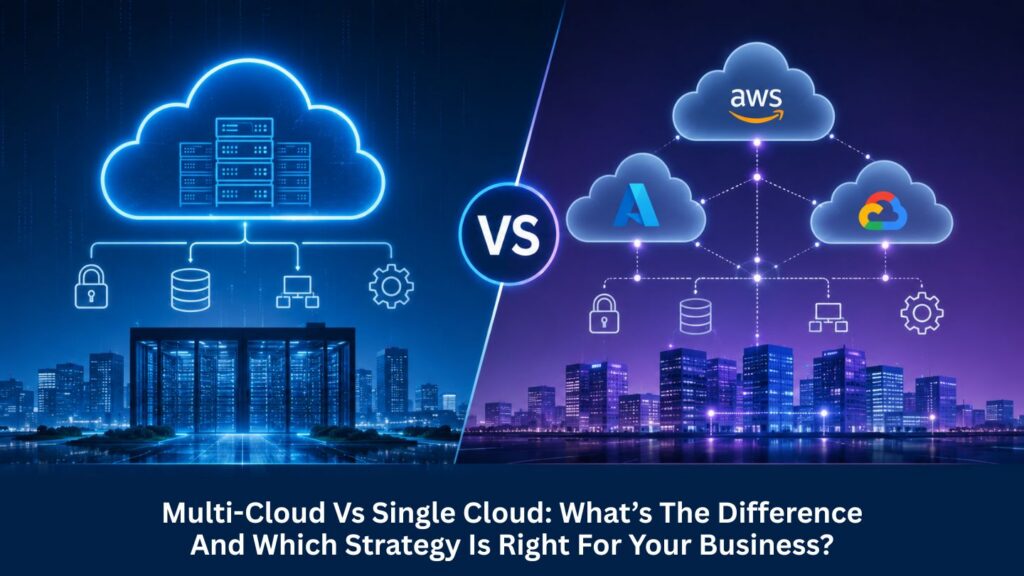
Choosing between cloud strategies has become one of the most consequential IT decisions Atlanta businesses face today. Whether you’re scaling operations in Alpharetta, expanding your Marietta headquarters, or optimizing infrastructure across the metro area, the question of multi-cloud vs single cloud, what’s the difference, sits at the center of your technology roadmap.
The answer directly impacts your budget, security posture, operational efficiency, and ability to grow. Single cloud environments centralize all computing resources and services on a single platform, which can simplify management but may also lead to vendor lock-in and limited flexibility. Multi-cloud strategies, on the other hand, leverage multiple cloud providers to distribute workloads and enhance resilience—but introduce their own complexities. This blog breaks down the core differences between these cloud computing approaches, examines the real costs and benefits of each, and provides a practical framework for determining which cloud strategy aligns with your business objectives.
Key Takeaways
- Single cloud uses one cloud provider for simplicity and cost control, while multi-cloud leverages multiple cloud providers for flexibility and redundancy
- Multi-cloud strategies can lead to optimized costs by allowing organizations to select the most suitable services for each workload, avoiding vendor lock-in
- Single-cloud environments offer streamlined operations but create potential single points of failure
- The right choice depends on your business size, technical requirements, budget, and risk tolerance
- Most Atlanta SMBs benefit from starting with a single cloud and evolving to multi-cloud as they grow
What is a Single Cloud Strategy?
A single cloud strategy means using one cloud provider—whether that’s Microsoft Azure, Amazon Web Services, or Google Cloud Platform—for all or nearly all of your public cloud computing needs. This approach centralizes your entire infrastructure under a single vendor relationship, a single set of APIs, a single billing structure, and a single security framework.
Single-cloud environments offer simplicity and ease of management, making them appealing for businesses with straightforward computing needs. For Atlanta businesses—startups, small companies, and organizations with standard IT requirements—this single cloud approach delivers immediate value through predictable costs, unified dashboards, and streamlined operations.
Many Metro Atlanta SMBs have standardized on Microsoft 365 combined with Azure for remote work capabilities, secure identity management, and disaster recovery. This single-vendor approach allows IT teams to develop deep expertise in a single platform rather than spreading knowledge thin across multiple cloud platforms.
Core Components of Single Cloud Infrastructure
When you commit to a single cloud platform, you’re accessing an integrated ecosystem that includes storage, computing resources, networking, and security from one provider. This unified approach means your data centers, identity management, compliance tools, and monitoring systems all speak the same language. Understanding the difference between cloud storage and cloud computing can help businesses better evaluate which cloud resources they need for data access, application performance, and long-term infrastructure planning.
A single provider can offer better integration and lower latency for interconnected systems, whereas multi-cloud might introduce performance issues due to data traveling between providers. For businesses with tightly coupled applications, this integration benefit alone can justify the single cloud approach.
Single cloud simplifies security monitoring and policy management. You maintain one set of access controls, one compliance framework to audit, and one vendor relationship to manage. For SMBs without extensive cloud engineering teams, this simplicity translates directly to lower operational overhead and fewer integration headaches.
What is a Multi-Cloud Strategy?

A multi-cloud approach enables organizations to use multiple cloud services from different providers, enhancing flexibility and optimizing various aspects of their computing needs. Rather than placing all workloads with a sole cloud provider, you strategically distribute services across AWS, Azure, Google Cloud, or other cloud platforms based on each provider’s strengths.
Multi-cloud refers to the intentional use of two or more independent cloud providers to host and distribute workloads, storage, and services. This differs from hybrid cloud, which typically combines on-premises private cloud infrastructure with public cloud services.
For Atlanta enterprises with complex requirements, multi-cloud strategies address scenarios like geographic distribution, specialized services, and enhanced disaster recovery. A multi-cloud strategy allows organizations to leverage the strengths of different cloud providers, enhancing flexibility and resilience in their IT infrastructure.
Common Multi-Cloud Implementation Mistakes to Avoid
Adopting a multi-cloud environment without proper planning leads to costly mistakes that can undermine the strategy’s benefits:
- Underestimating complexity: Many businesses treat multi-cloud as simply “adding another cloud” without planning for cross-cloud identity management, networking, logging, and governance. Multi-cloud environments increase complexity, requiring sophisticated management tools and specialized staff training.
- Inconsistent security policies: Different cloud environments have different security models. Without unified policy enforcement, gaps emerge that create vulnerabilities across your entire infrastructure.
- Poor cost visibility: Without standardized tagging across all clouds, engineering teams spin up resources without oversight. Egress charges surprise finance teams, and licenses get duplicated across various cloud providers.
- Over-reliance on proprietary services: Using heavily vendor-specific services across multiple providers doesn’t reduce vendor lock-in—it creates lock-in in multiple places simultaneously.
- Lack of unified operations: If monitoring tools, automation scripts, and CI/CD pipelines are tied to one provider only, adding more clouds creates brittle processes rather than resilient infrastructure.
Read More: Common Cloud Security Mistakes and How to Avoid Them
Key Differences Between Multi-Cloud and Single Cloud
Understanding the key differences between these cloud computing approaches helps clarify which strategy fits your business needs:
| Factor | Single Cloud | Multi-Cloud |
| Management Complexity | Lower: unified dashboards, common APIs, one identity domain. Teams develop deep expertise in one platform. | Higher: separate dashboards, disparate APIs, multiple IAM models. Teams must split skills across different cloud providers. |
| Cost Structure | More predictable billing, better volume discounts through commitment pricing, and simpler cost visibility. | Significant hidden costs: data egress fees, duplicate tooling, multiple contracts, skill fragmentation. |
| Vendor Lock-In Risk | Higher: switching cloud providers is expensive; proprietary services create dependencies. | Reduced if workloads are truly portable. But using vendor-specific services across clouds creates multiple lock-in points. |
| Disaster Recovery | Uses multiple regions within the same provider; simpler to orchestrate—risk: provider-wide outages affect all workloads. | Distributing workloads across providers in a multi-cloud setup provides higher redundancy against service outages. |
| Performance | Generally optimized for the provider’s network, predictable performance, and fewer network cross-hops. | Can optimize latency by selecting providers with data centers closer to users. Cross-cloud traffic may reduce performance. |
| Security & Compliance | Uniform compliance zones, consistent policy enforcement, and easier auditing. | More complex: multiple compliance regimes; more surface area for threats; more auditing complexity. |
Operational simplicity must be weighed against strategic flexibility when choosing between a multi-cloud and single-cloud strategy. For Atlanta businesses with specific geographic needs, performance considerations are particularly relevant given the metro area’s strong data center presence.
Cost Analysis: Single Cloud vs Multi-Cloud for Atlanta Businesses

The overall cost of cloud computing depends on various elements, including resource usage, pricing models, and the cloud providers selected. However, the structural cost differences between single-cloud and multi-cloud environments deserve careful analysis.
Single Cloud Cost Advantages
Single cloud often offers better volume discounts and lower operational costs. With spend concentrated under one provider, you gain negotiating leverage for committed use discounts. Billing is consolidated, making cost attribution and forecasting straightforward.
Single-cloud environments can offer cost savings by consolidating services under a single provider, making them ideal for businesses with straightforward needs. You maintain a single monitoring stack, a single set of security tools, and a single team trained on a single platform.
Multi-Cloud Cost Realities
Multi-cloud can incur higher overhead, but it helps avoid expensive, long-term vendor lock-in. The hidden costs, however, often surprise businesses:
- Cross-cloud data egress fees can represent 15-35% of infrastructure spend
- Management overhead adds a 12-18% additional labor cost premium
- Duplicate security tools, monitoring platforms, and licensing multiply expenses
- Organizations with multi-cloud waste approximately 25-35% more in cloud spend compared to well-optimized single-cloud operations when mature FinOps practices aren’t established
For Atlanta SMBs, these cost differences matter significantly. A business starting with a single cloud can secure reserved instance pricing and predictable monthly bills. Multi-cloud strategies can optimize costs by enabling organizations to select the most suitable services for each workload, avoiding vendor lock-in—but only when implemented with rigorous cost governance.
Security and Compliance Considerations
While multi-cloud strategies provide enhanced security through vendor diversification, they also introduce greater complexity in management and data integration. Understanding these tradeoffs is essential for Atlanta businesses in regulated industries. Industries that manage sensitive client information, such as legal and financial organizations, are increasingly prioritizing cloud security to protect client data, reduce exposure, maintain compliance, and build stronger trust with the people they serve.
Single Cloud Security Benefits
Single cloud simplifies security monitoring and policy management. You maintain consistent IAM policies, unified logging, and streamlined audit trails. Compliance certifications from one provider cover your entire cloud infrastructure.
For businesses with fewer cloud engineers, this simplified security posture reduces the risk of configuration mistakes and policy gaps that create vulnerabilities.
Multi-Cloud Security Complexity
Multi-cloud may be necessary to comply with specific data sovereignty or security regulations. Some industries or geographic requirements demand that certain data reside with specific providers or in specific regions.
However, managing multiple clouds means managing multiple security models. Each cloud provider has distinct identity management, network segmentation, and monitoring frameworks. Implementing comprehensive security measures and compliance frameworks is essential to protect data and applications across a multi-cloud environment.
For healthcare, finance, and other regulated industries in Atlanta, the choice often depends on the specific compliance certifications offered by each cloud provider and on data governance and compliance requirements.
Read More: Cloud Security Challenges and How to Overcome Them
How to Choose the Right Cloud Strategy for Your Business

Conducting a comprehensive assessment of your current infrastructure, applications, and business needs is crucial before transitioning to a multi-cloud model—or before committing more deeply to a single cloud provider. As companies expand, understanding the benefits of cloud computing for business growth can help leaders choose scalable systems that support flexibility, productivity, and future technology needs.
Business Size and Growth Trajectory
Smaller organizations with straightforward needs typically benefit from single cloud solutions. The simplicity allows limited IT resources to operate effectively. As organizations scale in team size, geographic reach, and technical complexity, multi-cloud becomes more viable.
Technical Requirements
If your business runs data analytics workloads that excel on Google Cloud Platform, AI training that benefits from specialized hardware, and enterprise applications optimized for Microsoft Azure, multi-cloud computing offers the flexibility to match workloads to optimal environments. If your applications are standard business tools with minimal compute variety, a single cloud gives you speed and simplicity.
Compliance and Regulatory Requirements
Certain regulations require data locality or specific certifications that may be available only from certain cloud providers. Multi-cloud gives flexibility to ensure data compliance across different jurisdictions.
Risk Tolerance and Resilience Objectives
How critical is uptime? What business impact does downtime create? If you need high availability across geographic regions and protection against provider-level outages, multi-cloud provides insurance—at a higher cost and complexity.
IT Maturity and Capability
Does your team have experience managing multiple cloud platforms? Can they handle cross-cloud networking, unified identity, and complex orchestration? Organizations without extensive cloud engineering teams often benefit from a single cloud until their capabilities mature. Developing a phased migration strategy that prioritizes workloads and applications for transition can minimize disruption during the shift to a multi-cloud environment. Starting with a single cloud and planning for potential evolution to multi-cloud represents a pragmatic path for most Atlanta SMBs.
Read More: How to Choose the Right Cloud Service Provider
Final Thoughts
Choosing the right cloud strategy requires balancing flexibility, cost, security, and long-term operational goals. While single cloud environments offer simplicity and streamlined management, multi-cloud strategies can provide additional resilience, scalability, and workload flexibility for businesses with more complex infrastructure needs. Understanding these differences helps organizations build a cloud environment that supports growth while minimizing unnecessary complexity and operational risk.
For businesses exploring cloud computing in Atlanta, JETT Business Technology provides strategic guidance, cloud infrastructure support, and scalable technology solutions designed to improve operational efficiency, strengthen security, and support long-term business continuity. Our team also delivers reliable IT installation and support, dependable backup and disaster recovery solutions, and proactive security services to help businesses maintain stable and protected IT environments. Contact us today to build a smarter and more resilient cloud strategy for your business.
Frequently Asked Questions
What are the main cost differences between single cloud and multi-cloud for small businesses?
Single cloud typically offers lower total costs through volume discounts, simplified billing, and reduced operational overhead. Multi-cloud introduces hidden costs, including data egress fees (often 15-35% of infrastructure spend), duplicate security tools, multiple contracts, and the need for broader staff training. Organizations without mature cost governance practices waste 25-35% more in multi-cloud environments.
How do I know if my Atlanta business is ready for a multi-cloud strategy?
Readiness indicators include having dedicated IT staff with cross-platform expertise, workloads that genuinely benefit from different providers’ strengths, regulatory requirements demanding specific provider capabilities, and established FinOps practices for cost visibility. If managing one cloud environment already strains your resources, multi-cloud will amplify those challenges.
Can I start with a single cloud and migrate to multi-cloud later?
Yes—this represents the recommended path for most SMBs. The key is designing your single cloud environment with portability in mind: use containers, avoid over-reliance on proprietary services, and maintain documentation. Developing a phased migration strategy that prioritizes workloads for transition can minimize disruption when the time comes.