
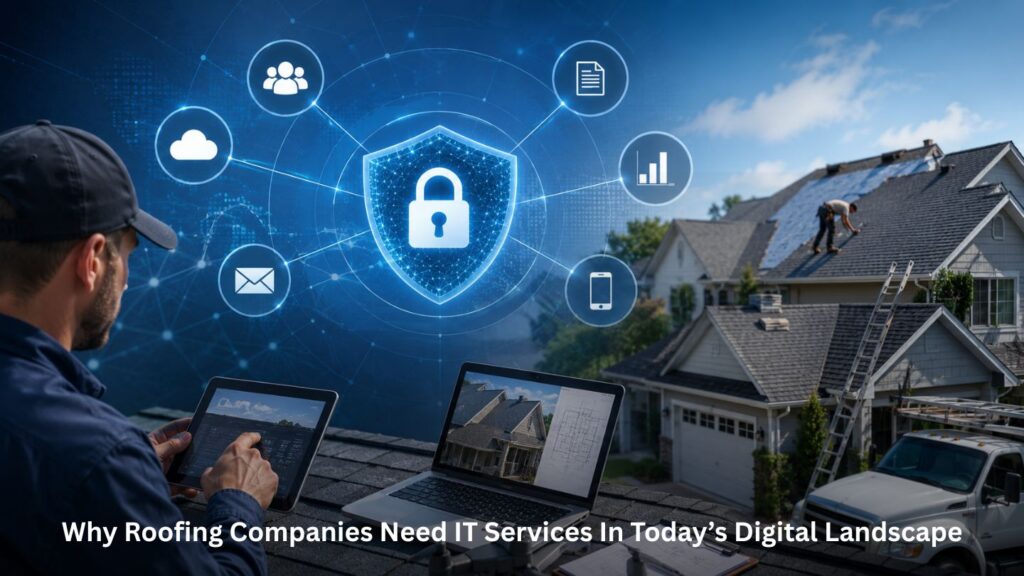
Roofing companies that ignore professional IT support are leaving money, security, and competitive advantage on the table. According to the 2025 State of the Roofing Industry Report, 71% of residential roofers have adopted estimating software, while 62% use enterprise accounting technology, clear evidence that understanding why roofing companies need IT services in today’s digital landscape is no longer optional. This blog breaks down the technology dependencies, cybersecurity threats, and efficiency gains that make professional IT services essential for modern roofing business success.
Key Takeaways
- Roofing companies face increasing cybersecurity threats without proper IT protection, with construction ranking among the top three most targeted sectors for ransomware globally
- Modern roofing operations depend on digital tools, cloud storage, and mobile technology for daily operations
- IT services improve customer communication and project management efficiency, with tech-savvy roofers closing deals 16-20% faster
- Professional IT support prevents costly downtime and data loss incidents through proactive monitoring and secure data backups
- Competitive edge requires reliable technology infrastructure and support to meet client expectations for a frictionless digital experience
The Digital Revolution in Modern Roofing Operations
The roofing industry has undergone a fundamental transformation. Traditional paper-based processes have given way to cloud-based solutions that enable roofing teams to access files, schedules, and customer information from anywhere. More than 54% of contractors now use drones for inspections, while approximately 61% rely on satellite and aerial measurements for accurate estimates.
This shift extends across every aspect of operations. Estimating software generates precise material and labor calculations using aerial imagery. CRM systems track customer interactions and manage leads efficiently. Project management platforms coordinate crews, materials, and schedules in real time. GPS tracking streamlines routing, while drone technology and GIS mapping allow for faster, more accurate roof measurements and inspections.
AI adoption among roofing contractors has risen sharply from roughly 29% in 2024 to about 40% in 2025, with another 36% planning to implement it over the next 18 months. A 3.5% annual rise in technology adoption is anticipated in field service industries like roofing through 2026, and 55% of projects are expected to use drones for inspection and measurement.
Technology Dependencies That Require Professional IT Support
Roofing professionals now rely on an interconnected ecosystem of technology for daily operations. Scheduling software dispatches crews. Cloud systems store job photos, project notes, and documentation. Communication tools coordinate between field teams and office staff. Financial software handles estimates, invoicing, and payroll.
The complexity multiplies when integrating multiple software platforms and devices. Estimating tools must sync with CRM systems. Customer invoices must be aligned with the accounting software. Field data from tablets and smartphones must feed back into office dashboards. Managing this technology stack across multiple locations demands consistent software versions, secure connectivity, and professional support.
System failures directly impact operations and customer satisfaction. A roofing company can experience significant operational disruptions when IT systems fail, resulting in job delays, frustrated customers, and stalled revenue. When cloud storage lags, servers go down, or mobile apps crash, material ordering stops, billing halts, and schedules fall apart.
Read More: What Questions Should You Ask Before Hiring an IT Support Company?
Critical Cybersecurity Threats Targeting Roofing Companies
Construction and roofing rank among the top three most targeted sectors globally for ransomware. Between April 2023 and March 2024, 228 ransomware victims were reported in the construction industry. Construction and real estate were cited as the number one U.S. sector breached in 2023, with over 1.5 billion records compromised.
Roofing companies handle sensitive information such as customer names, addresses, and payment records, making them targets for cyber-attacks. Common attack vectors include phishing emails, business email compromise, weak passwords, and unpatched legacy software. Attackers exploit third-party vendors and supply chain connections to gain access.
Cybersecurity threats are becoming more sophisticated each year, making proper IT security essential for businesses handling sensitive customer information. Real consequences have already hit the industry.
Effective cybersecurity measures include firewalls, secure data backups, encrypted communication tools, and safe cloud storage to protect both the business and customer data. Without these protections, roofing businesses face financial penalties, legal liability, operational disruption, and reputational damage that can take years to recover from. Regularly performing a cybersecurity risk assessment helps roofing businesses identify weaknesses before attackers exploit them, strengthening long-term protection for customer and business data.
Common IT Security Mistakes Roofing Companies Make
Many roofing contractors lack formal cybersecurity policies or incident response plans. Most do not have dedicated cybersecurity staff. Weak controls over mobile devices, remote access, and user permissions create vulnerabilities that attackers exploit. When attackers gain access through weak permissions or compromised devices, lateral movement in cybersecurity becomes a serious concern because it allows threats to spread across systems and reach sensitive business information.
Unsecured storage presents a significant risk. Customer data, financial documents, contracts, blueprints, and job photos are sometimes stored in unencrypted cloud storage or shared drives without access control. This exposes sensitive information to theft and misuse.
Backups are often ad-hoc or incomplete. Disaster recovery planning remains reactive rather than proactive. Small businesses in the roofing industry have lost revenue, clients, and reputation due to preventable system outages or data loss. Data breach remediation, legal penalties, and client compensation create substantial unexpected costs.
Routine backups and response playbooks ensure that if a device is lost or a system is hit by ransomware, the company can recover quickly. Without these safeguards, a single incident can devastate operations.
Read More: Common Cloud Security Mistakes and How to Avoid Them
How Professional IT Services Transform Roofing Business Efficiency
Utilizing IT services in the current digital environment provides roofing companies with significant operational, safety, and competitive advantages. Managed IT providers help companies move from reactive troubleshooting to proactive technology management, aligning IT investments with business strategy. For roofing teams managing job photos, estimates, schedules, and customer records, understanding the benefits of cloud migration can help improve accessibility, reduce infrastructure strain, and support faster collaboration between field and office teams.
IT services prevent downtime by monitoring systems, preventing outages, installing updates, managing hardware, fixing issues quickly, providing helpdesk support, and backing up data routinely. Proactive IT support is essential for minimizing workflow disruptions and ensuring roofing companies can maintain operations even during unexpected technical issues.
Cloud-based solutions allow roofing companies to securely store project files, customer details, and reports while enabling real-time collaboration among team members. Using cloud computing, roofing teams can access files, schedules, and customer information from anywhere, improving collaboration and reducing IT infrastructure costs. Cloud systems facilitate faster communication and coordination, allowing sales representatives to upload photos from the field while office staff prepares estimates almost instantly.
Companies using service management software report up to 30% higher productivity. AI-powered tools can generate precise material and labor estimates in minutes using aerial imagery, reducing human error and cutting inspection times by 30-40%.
Automation reduces manual tasks such as scheduling and invoicing, thereby improving operational efficiency. Automated workflows and cloud-based job management systems can significantly reduce administrative tasks, allowing roofing companies to focus more on revenue-generating activities. Digital workflows enable companies to scale operations without adding extra administrative staff. One national commercial roofer migrated to a managed private cloud and backup solution, achieving 99.9% uptime and dramatically reducing delays and operational disruptions.
Final Thoughts

Professional IT services have become essential for roofing companies that depend on digital tools, cloud systems, mobile communication, and secure data management to stay competitive. From protecting customer information to reducing downtime and improving project coordination, reliable technology support helps roofing businesses operate more efficiently and prepare for long-term growth.
For businesses seeking IT services for a roofing company, JETT Business Technology provides strategic support to strengthen daily operations, secure sensitive data, and build a dependable technology foundation for modern roofing teams. We also support a wide range of industries with specialized solutions, including IT services for HVAC company operations, customized IT services for physical therapy providers, scalable IT solutions for manufacturing company environments, and secure IT services for law firms handling sensitive business and client data. Contact us today to make your roofing business more secure, connected, and future-ready. When cloud storage lags, servers go down, or mobile apps crash, material ordering stops, billing halts, and schedules fall apart., and future-ready.
Frequently Asked Questions
What IT challenges do roofing companies face most often?
Roofing companies commonly struggle with system downtime that halts operations, security breaches exposing customer data, difficulty integrating multiple software platforms, and inadequate backup systems. Delayed lead follow-ups, inefficient material and labor scheduling, and poor coordination between field crews and office staff also create significant operational friction.
How much should a roofing company budget for IT services?
Budget depends on company size and technology maturity. Smaller firms might invest tens of thousands of dollars annually in basic cloud solutions, CRM systems, and cybersecurity fundamentals. Larger operations may budget hundreds of thousands for full platform integrations, cloud migration, and advanced capabilities. ROI typically materializes within 6-12 months through saved labor, faster lead conversion, fewer errors, and reduced risk exposure.
Can cloud computing really improve roofing operations?
Cloud computing delivers concrete benefits for roofing teams. Field technicians access job details, upload photos, and update project notes from any location. Office staff prepares estimates using real-time field data. Secure data backups protect against device loss or system failures. Scalable storage handles large photo and video files. Real-time synchronization keeps everyone aligned, improving time savings and customer communication.