
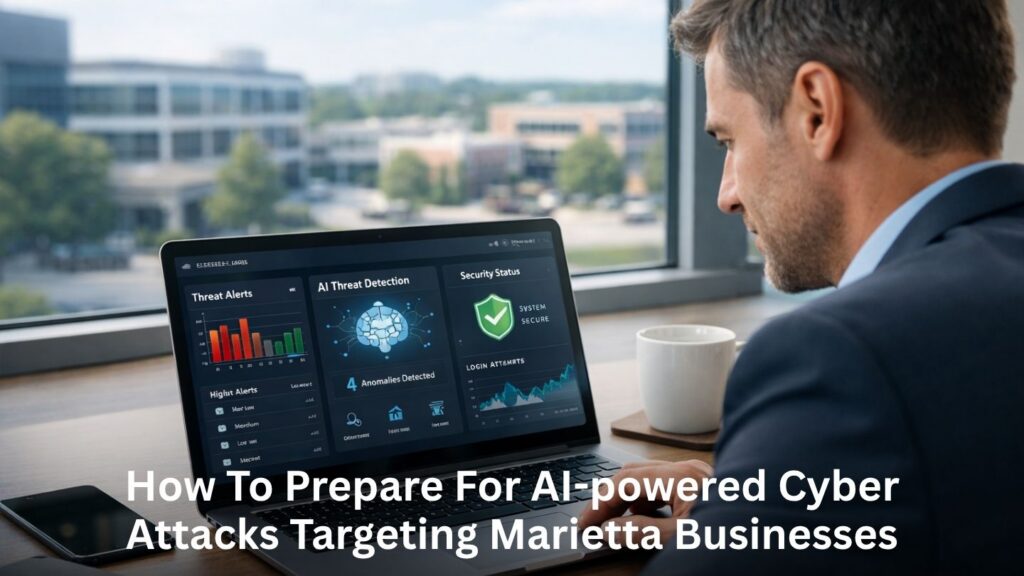
A growing number of U.S. small businesses have experienced cyber incidents in recent years, and AI-powered attacks are driving that number higher every quarter. For Marietta businesses operating in Cobb County’s growing economy, artificial intelligence has transformed the cybersecurity battlefield from a manageable risk into an urgent threat requiring immediate attention.
AI-driven cyber threats now enable attackers to craft hyper-realistic phishing emails, generate convincing deepfake voice calls, and deploy adaptive malware that rewrites itself to evade traditional security measures. Marietta’s professional services firms, healthcare practices, and manufacturing companies hold exactly the type of valuable data, client records, financial information, and trade secrets that make them prime targets for these sophisticated attacks.
This blog provides Marietta business owners with a complete preparation framework covering threat understanding, essential defense steps, advanced protection technologies, and incident response planning. You’ll learn how to protect your business against AI-powered attacks that are already targeting companies in our region.
Key Takeaways
- AI-powered cyber attacks target Marietta businesses through sophisticated phishing, deepfake calls, and adaptive malware that evolves in real-time
- Traditional security measures like basic antivirus software are insufficient against AI-driven threats that learn and adapt
- Layered defense strategies combining AI-powered security tools, employee training, and incident response plans provide essential protection
- Regular security assessments and continuous monitoring help detect threats before they cause catastrophic damage
- Professional cybersecurity partnerships deliver 24/7 protection and expert threat detection at costs manageable for small businesses
Understanding AI-Powered Threats Targeting Marietta Businesses
AI has fundamentally changed how cyber attacks work. Attackers now use machine learning algorithms to generate phishing emails that perfectly mimic your actual vendors, clients, and partners. These AI-generated phishing messages analyze your business relationships, communication patterns, and even writing styles to create messages virtually indistinguishable from legitimate correspondence.
Deepfake technology presents an equally serious threat. In one documented case, attackers used an AI-synthesized video of a CFO during a video call to authorize a $25 million wire transfer. Similar voice deepfakes have compromised 27 cloud clients through a single IT company breach. For Marietta executives and finance departments, a phone call that sounds exactly like your business partner requesting an urgent payment could be an AI-generated deception.
AI-powered malware represents the third major threat vector. Unlike traditional attacks that use static code signatures, adaptive malware continuously rewrites itself to evade detection. This polymorphic behavior means your antivirus software identifies the threat in one form while it’s already morphed into something unrecognizable on your network.
Marietta’s healthcare practices hold protected health information. Manufacturing companies maintain trade secrets and supplier relationships. Professional services firms manage sensitive client data across multiple industries. Each sector presents attackers with high-value targets and multiple entry points.
Why Marietta Companies Are Vulnerable
The gap between enterprise-level security and typical SMB protections in Marietta creates significant exposure. Large corporations deploy dedicated security teams, advanced AI threat detection platforms, and continuous monitoring capabilities. Most Marietta businesses operate without any of these protections.
Survey data indicates that fewer than half of small businesses allocate more than 1% of their IT budget to cybersecurity. This funding gap leaves companies with outdated infrastructure, unpatched systems, and security tools that cannot identify vulnerabilities created by modern cyber threats.
Recent local incidents underscore this vulnerability. In February 2026, a ransomware attack on payment gateway vendor BridgePay disrupted the City of Marietta’s online payment processing. The March 2025 breach of Cobb County systems by the Qilin ransomware group exposed Social Security numbers and driver’s licenses. These incidents demonstrate that AI-driven attacks are already affecting our region’s government and business infrastructure.
Marietta’s business growth creates an attractive target profile: companies with valuable data but limited security budgets, often relying on legacy systems never designed to counter AI-powered cyberattacks.
Essential Preparation Steps for AI Cyber Defense
Preparation begins with understanding exactly what you need to protect. Conduct a comprehensive cyber risk assessment that maps every asset containing sensitive data, customer databases, financial records, employee information, intellectual property, and vendor credentials. Identify which systems are exposed through web portals, remote access tools, email servers, and cloud services that require strong data protection.
Multi-factor authentication MFA must be implemented across all business systems. However, avoid SMS-based authentication, which attackers can intercept. Use app-based authenticators or hardware security tokens that resist AI-driven credential theft attempts.
Deploy AI-powered cybersecurity solutions, such as endpoint detection and response platforms, that monitor all devices connected to your network. These AI tools establish behavioral baselines for normal activity, then flag unusual patterns that indicate potential compromise. Traditional antivirus software cannot match this capability against AI-driven threats.
Establish data backup and recovery procedures that include offline or air-gapped storage. Ransomware attacks targeting Marietta businesses will encrypt everything connected to your network. Offline backups remain your only recovery option when affected systems are inaccessible.
Create security awareness training programs specifically addressing AI threats. Your employees need to recognize AI-generated phishing attempts, understand verification procedures for unusual requests, and know how to report suspicious messages without clicking suspicious links.
Common Preparation Mistakes to Avoid
Relying solely on traditional antivirus software provides false confidence against AI-powered malware that mutates to evade signature-based detection. These tools catch known threats but miss the adaptive attacks specifically designed to bypass them.
Skipping employee training on AI-generated phishing and deepfake communications leaves your organization’s biggest vulnerability unaddressed. Human error remains the primary entry point for cyber attacks, and AI makes social engineering dramatically more convincing.
Failing to test backup systems and incident response procedures means discovering they don’t work during an actual crisis. Schedule quarterly restoration tests and tabletop exercises that validate your recovery capabilities.
Implementing security tools without proper configuration and continuous monitoring creates security gaps that attackers quickly exploit. AI-enhanced security tools require ongoing tuning and professional oversight to maintain effectiveness.
Read more: Common Cloud Security Mistakes and How to Avoid Them
Advanced Defense Technologies and Strategies
Behavioral analytics tools provide critical protection by modeling normal patterns across your network traffic, user activities, and data access, complementing defenses against common types of cyber attacks. When an employee’s account suddenly accesses files at unusual hours from an unfamiliar device, these systems generate immediate alerts. This capability catches AI-driven attacks that evade traditional signature-based detection.
Zero Trust architecture operates on a simple principle: never trust any access request without continuous verification. Every user, device, and connection must prove legitimacy repeatedly, not just at initial login. Approximately 41% of organizations with 1-249 employees have implemented partial or full Zero Trust strategies, recognizing that perimeter-based security cannot stop modern cyber threats.
AI-powered threat intelligence platforms gather data on emerging attack patterns, deepfake campaigns, and new malware signatures from global sources. These platforms adapt to new threat vectors faster than human analysts can track, providing early warning signs of attacks targeting your industry or region.
Network segmentation divides your infrastructure into isolated zones, administrative systems, financial applications, guest WiFi, and operational technology. When attackers breach one segment, segmentation prevents lateral movement to your most sensitive data. This containment strategy limits damage from even successful intrusions.
Email security gateways with AI-based phishing detection scan incoming messages in real-time, analyzing content, attachments, and URLs against patterns indicating AI-generated phishing. These systems catch phishing emails that would fool even trained employees.
Creating an Incident Response Plan for AI Attacks
An incident response plan transforms chaos into coordinated action when AI-powered attacks strike. Document specific procedures for detection, containment, eradication, and recovery with clear role assignments so everyone knows their responsibilities before a crisis occurs.
Establish out-of-band communication channels that function when your primary systems are compromised. If attackers control your email, you need secure alternatives for coordinating response efforts, encrypted messaging apps, dedicated phone trees, or pre-arranged meeting protocols.
Create contact lists for legal counsel familiar with data breach notification requirements, forensic investigators who can preserve evidence, and cybersecurity experts who provide incident response services. Having these relationships established before an attack saves critical time during the response.
Design containment strategies specific to AI-powered threats. Deepfake impersonation requires immediately disabling compromised user accounts and implementing secondary verification for all financial transactions. AI-powered malware demands rapid isolation of affected systems and network segments to prevent spread.
Practice tabletop exercises simulating AI-driven attack scenarios quarterly. Walk through a realistic deepfake phone call requesting a wire transfer, or a phishing attack that compromised executive credentials. These exercises expose gaps in your incident response plan before real attackers do.
Read more: What Is a Cybersecurity Incident Response Plan & Why Do You Need It?
Response Team Roles and Responsibilities
The incident commander makes final decisions during active threats, balancing business continuity against security requirements. This person needs authority to shut down systems, engage external resources, and communicate with leadership.
Technical response team members handle containment, evidence preservation, and system recovery. They isolate affected systems, capture forensic images, analyze attack vectors, and restore operations from clean backups.
Communication leads manage internal updates for employees and external notifications to customers, regulators, and partners. Georgia breach notification laws require specific disclosures within defined timeframes; your communication lead ensures compliance while protecting your business reputation.
Ongoing Protection and Monitoring
Continuous monitoring with AI-powered threat detection capabilities catches attacks that point-in-time assessments miss. Threats evolve constantly; monitoring must operate around the clock to identify suspicious activity before attackers establish persistence in your network.
Schedule quarterly vulnerability assessments that scan for new weaknesses in your infrastructure, including physical and access-control exposures that can enable tailgating attacks in cybersecurity. Annual penetration testing by qualified professionals simulates real attack scenarios, revealing how AI-driven threats could exploit vulnerabilities your automated tools might miss, and often pairs well with managed small business IT support services that maintain ongoing safeguards between tests.
Maintain rigorous patch management for operating systems, applications, and network devices. Unpatched systems provide easy entry points for attackers; automated patching reduces the window of exposure while minimizing disruption to business operations.
Monitor dark web activity for compromised business credentials and data. When employee login credentials appear for sale, you gain early warning to reset passwords and investigate potential breaches before attackers exploit their access.
Review and update security policies every six months to address new AI threats. The threat landscape evolves faster than annual reviews can track; semi-annual updates ensure your defenses keep pace with emerging attack techniques.
Building Resilience Against Evolving Cyber Threats
AI-powered cyber attacks are becoming more advanced, making it critical for businesses to stay proactive with security strategies. By understanding emerging threats, strengthening defenses, and implementing continuous monitoring, companies can reduce vulnerabilities, protect sensitive data, and maintain operational stability in an increasingly complex digital landscape.
JETT Business Technology delivers trusted cybersecurity in Marietta to help businesses defend against evolving threats with confidence. We provide IT installation and support, cloud services, as well as low-voltage and premise security services to strengthen your overall infrastructure. Contact us to help you stay protected, minimize risks, and move forward with a secure and future-ready technology strategy.
Frequently Asked Questions
How quickly can AI-powered attacks compromise a Marietta business network?
AI-powered attacks can compromise business networks within minutes to hours, not the days or weeks traditional attacks required. Automated phishing campaigns deploy instantly, and once credentials are captured, attackers use AI to navigate networks rapidly. Organizations that respond to email security breaches within nine hours significantly reduce secondary attack risks; delays open doors to ransomware deployment and data exfiltration.
Can small Marietta businesses afford enterprise-level AI cybersecurity tools?
Yes, through managed security service providers that deliver enterprise-grade AI threat detection and response at monthly costs scaled to SMB budgets. Rather than building internal dedicated security teams, small businesses can outsource 24/7 monitoring, incident response, and security management. This approach provides access to AI-powered security tools and expert analysts without capital investment in technology or full-time security staff.
How often should Marietta businesses update their AI cyber defense strategies?
Quarterly security reviews with monthly monitoring adjustments represent the minimum frequency given the rapidly evolving AI threat landscape. Semi-annual policy updates address new attack techniques, while annual penetration testing validates overall defense effectiveness. The speed of AI-driven threats means defenses that worked three months ago may have gaps today.
What role do employees play in defending against AI-powered social engineering?
Employees serve as both the primary target and the critical last line of defense against AI-powered social engineering. Simulated phishing campaigns build recognition skills for AI-generated phishing attempts. Training should emphasize verification procedures: confirming unusual requests through secondary channels, recognizing warning signs of deepfake communications, and reporting suspicious activity without shame. Even the strongest security tools fail if employees trust a convincing voice deepfake or click a carefully crafted malicious link.
Should Marietta businesses invest in AI-powered security tools or hire cybersecurity staff?
A hybrid approach using managed security services typically provides optimal cost-effectiveness and expertise for Marietta SMBs. Hiring qualified cybersecurity professionals requires salaries often exceeding $100,000 annually, plus training, tools, and coverage gaps during vacations or turnover. Managed services provide 24/7 coverage, access to the right partner with specialized expertise, and AI-powered security tools maintained by professionals, typically at a lower total cost than building internal capabilities from scratch.