 Skip to content
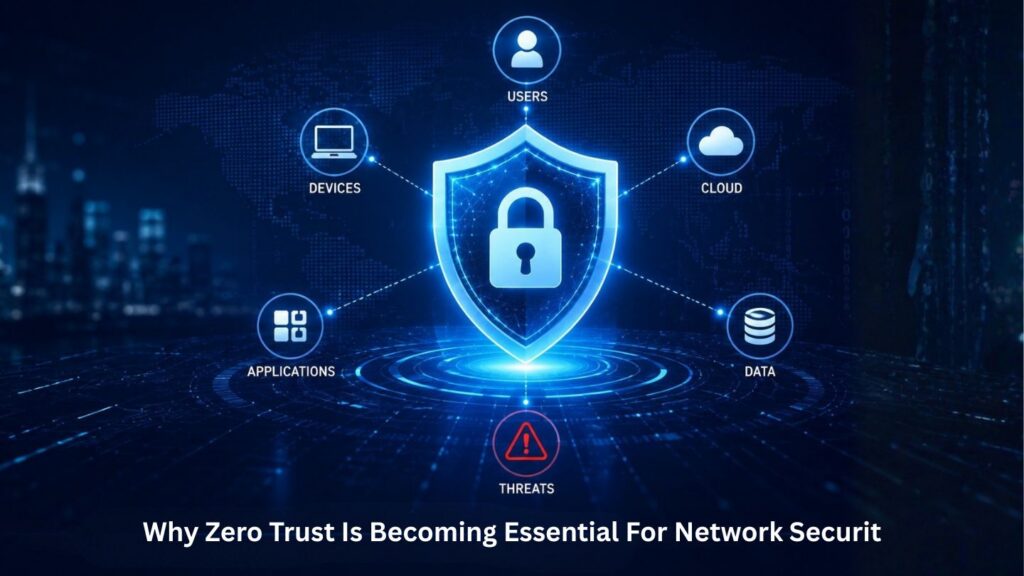
In 2025, data breaches reached record highs, with the average global breach cost climbing to $5.12 million and over 3,300 confirmed breaches in the U.S. alone. For businesses across Atlanta and beyond, the message is clear: traditional security approaches can no longer protect modern networks. The zero-trust security model is revolutionizing how organizations defend their IT infrastructure by operating under a simple but powerful principle: never trust, always verify. This blog explores why perimeter-based security models are failing, examines the rising threats driving zero-trust adoption, and outlines the key benefits of making zero-trust architecture essential for businesses navigating today’s threat landscape.
Key Takeaways
- Traditional perimeter-based security fails because remote work, cloud services, and mobile devices have eliminated clear network boundaries
- Cybersecurity threats continue escalating, with identity-based attacks involved in 65% of initial breach access, making continuous verification crucial
- Organizations with zero trust reduce incident frequency by approximately 29% and high-severity incidents by 36% compared to traditional security models
- Implementation requires strict identity verification, microsegmentation, and continuous monitoring of user behavior and device health
- Small to medium businesses benefit significantly from zero trust principles through managed service providers who can guide implementation without requiring extensive in-house cybersecurity staff
Why Traditional Network Security Models Are Failing
Castle-and-moat security operated on a flawed assumption: that threats exist outside the network perimeter and that everything inside can be trusted. Once users or devices passed the firewall, they gained broad access to network resources with minimal scrutiny. This approach worked when employees operated from fixed office locations using company-managed devices. As businesses adapt to remote access, cloud platforms, and expanding digital systems, understanding the essence of cybersecurity becomes essential for protecting sensitive data and maintaining operational trust.
The shift to cloud services and remote work has rendered traditional perimeter-based security models obsolete, leading to an expanded attack surface that organizations must secure. Remote workers now connect from home networks, coffee shops, and airports. Cloud environments host critical applications and sensitive data outside corporate data centers. Mobile devices, personal laptops, and IoT endpoints multiply entry points exponentially.
Once attackers breach the perimeter, lateral movement allows them to traverse the entire network, harvesting credentials and accessing critical assets. Studies show that in environments without zero-trust network access, only about 31% of threats are automatically mitigated before reaching critical assets, compared to nearly 94% in zero-trust environments.
Insider threats compound the problem. Research indicates that insider threats climbed 58% with the adoption of remote work, and remote workers are three times more likely to expose data than those working in the office accidentally. Traditional security models offer little protection against authorized users with excessive privileges.
The Digital Transformation Impact on Network Perimeters
The proliferation of Internet of Things (IoT) devices is creating vulnerabilities that zero trust can help manage by treating every connection as a potential threat. Hackers often target IoT devices because they can be used to introduce malware into vulnerable networks, posing a significant risk to enterprise security. From smart thermostats to connected medical equipment, these devices expand the attack surface while often lacking robust security controls.
Rising Cybersecurity Threats Driving Zero Trust Adoption

The 2025-2026 threat landscape demands a fundamental shift in security strategy. Zero trust is necessary due to the rise in sophisticated cyberattacks that traditional defenses often fail to prevent. AI-powered attacks are amplifying risks. Attackers leverage AI for sophisticated phishing campaigns, deepfake impersonation, and automated credential stuffing, all of which exploit traditional trust assumptions. As attackers increasingly use automation, phishing, and deepfake tactics, the role of artificial intelligence in cybersecurity is becoming increasingly important for identifying risks and strengthening threat response.
Key factors driving zero trust adoption include remote work, increased cloud computing adoption, and the rise of sophisticated cyberattacks. Regulatory pressure intensifies this shift. Governments and industry bodies are mandating zero trust architectures to comply with data protection laws such as GDPR, HIPAA, and PCI DSS. The NSA released Phase One and Phase Two of its Zero Trust Implementation Guidelines in early 2026, providing modular guidance aligned with federal maturity definitions. HIPAA Security Rule updates proposed in December 2024 include requirements consistent with zero trust principles, mandatory multi-factor authentication (MFA), network segmentation, encryption, and comprehensive asset inventories.
Supply chain vulnerabilities persist as significant attack vectors. Nearly half of organizations globally experienced a breach through third-party access in the past 12 months, underscoring the need for strict access controls that extend beyond internal users.
Common Security Implementation Mistakes to Avoid
Many organizations undermine their security posture through preventable errors:
- Assuming internal network traffic is safe: The zero trust model addresses vulnerabilities of traditional “castle-and-moat” security and is essential for modern, distributed work environments. Every access request must be authenticated regardless of origin.
- Over-privileged user access: The principle of least privilege in zero trust ensures that users and devices are granted only the minimum level of access necessary to perform their tasks, thereby limiting potential damage from compromised credentials. Implementing least-privilege access involves carefully managing user permissions, ensuring that each user’s access is limited to what is essential for their role.
- Inadequate monitoring of device health and user behavior: Continuous monitoring and validation are essential in a zero-trust environment, requiring that every access request be authenticated and authorized based on various contextual factors, such as user privileges and device health. The explosion of unmanaged mobile devices necessitates strict security posture checks before allowing network access.
- Poor network segmentation: Without microsegmentation, attackers who gain initial access can move freely across network segments, accessing other network resources and escalating privileges. Studies show network segmentation reduces the average “blast radius” of incidents by approximately 92%.
Key Benefits of Making Zero Trust Essential for Business Security

The Zero Trust security model operates under the principle of ‘never trust, always verify,’ meaning that no user, device, or workload is trusted by default, regardless of their location within the network. This approach delivers measurable security improvements across multiple dimensions. Even with stronger access controls in place, having a clear cybersecurity incident response plan helps businesses respond faster, limit damage, and recover more effectively after a security event.
- Minimized breach impact: Zero trust mitigates breach impact by implementing granular access controls and strict identity verification measures. Zero Trust assumes that breaches are inevitable, leading to a security posture that includes proactive measures such as network segmentation and real-time monitoring to contain threats that have bypassed initial defenses. Federal implementations demonstrated that data exfiltration attempts decreased by nearly 77%, and successful data theft incidents declined by 94%.
- Enhanced visibility and control: Zero Trust architectures continuously track the location, status, and health of every IoT device across an organization, treating each device as a potentially malicious entity. Security teams gain comprehensive insight into network traffic, user identities, and access patterns across cloud environments and on-premises systems.
- Regulatory compliance alignment: Zero trust provides a unified way to secure APIs, microservices, and data in multi-cloud and hybrid environments. Organizations across healthcare, finance, and other regulated industries find that zero-trust principles naturally support compliance requirements for access management, data security, and audit capabilities.
- Cost savings: Organizations using zero trust architecture saved an average of $1.76 million per incident compared to those without. Reduced incident response burden, minimized downtime, and faster recovery translate directly to bottom-line savings.
- Multi-factor authentication strength: Multi-factor authentication (MFA) is essential for Zero Trust security as it requires users to provide multiple forms of identification before gaining access, significantly increasing security against unauthorized access. MFA enhances security by requiring multiple pieces of evidence to authenticate a user, such as a password and a code sent to a mobile device, making it harder for attackers to gain access. Implementing MFA can increase the difficulty for hackers to gain access by requiring multiple user-specific credentials, thus reducing the risk of credential theft and phishing attacks.
- Microsegmentation effectiveness: Microsegmentation involves breaking networks into isolated zones to prevent lateral movement, ensuring that even if an attacker breaches one segment, they cannot move freely across the environment. By implementing microsegmentation, organizations can create precise, resource-specific access policies, which help contain breaches and minimize their impact. Microsegmentation helps to limit the attack surface by ensuring that access to different parts of the network requires separate authorization, effectively quarantining threats.
- Least-privilege access protection: Least-privilege access ensures that users and devices are granted only the minimum level of access necessary to perform their specific functions, thereby reducing the risk of unauthorized access to sensitive data. In a zero-trust environment, least-privilege access is a critical principle that helps limit the potential damage from compromised credentials or insider threats by restricting access to only what is necessary for users to perform their tasks.
Final Thoughts
Traditional perimeter security can no longer fully protect modern businesses operating across remote work environments, cloud platforms, and connected devices. As cyber threats continue to evolve, adopting a zero-trust approach helps organizations strengthen access control, improve visibility, and reduce the impact of potential breaches while maintaining a more resilient security posture. Businesses can further support their infrastructure with reliable IT installation and support, scalable cloud services, and dependable backup and disaster recovery solutions.
For businesses looking to improve cybersecurity in Marietta, JETT Business Technology provides strategic guidance and tailored solutions designed to support secure network access, threat prevention, and long-term operational protection. Our team helps businesses implement modern security practices that align with today’s evolving digital landscape. Contact us today to strengthen your business against tomorrow’s cyber threats.
Frequently Asked Questions
What makes zero trust different from traditional firewalls and antivirus software?
Zero trust is an architecture and policy framework, not a single product. While firewalls and antivirus remain components of a security stack, zero trust focuses on continuous validation of users, devices, and applications, contrasting with perimeter-based security. Zero trust requires strict identity verification for every access request, regardless of whether it originates inside or outside the network perimeter.
How long does it typically take to implement zero trust for a small business?
Initial gains, such as implementing multi-factor authentication, device posture checks, and basic identity and access management, can be achieved within months. Achieving full maturity across all pillars, including network segments, microsegmentation, and automated policy enforcement, typically takes 12-24 months, depending on existing infrastructure complexity and available resources.
Can zero trust work with existing network infrastructure and cloud services?
Yes. Zero-trust principles integrate with existing systems through a phased implementation. Organizations can begin by securing access to critical assets and sensitive data, then progressively extend zero-trust access controls across additional network resources, cloud environments, and legacy applications without requiring complete infrastructure replacement.