
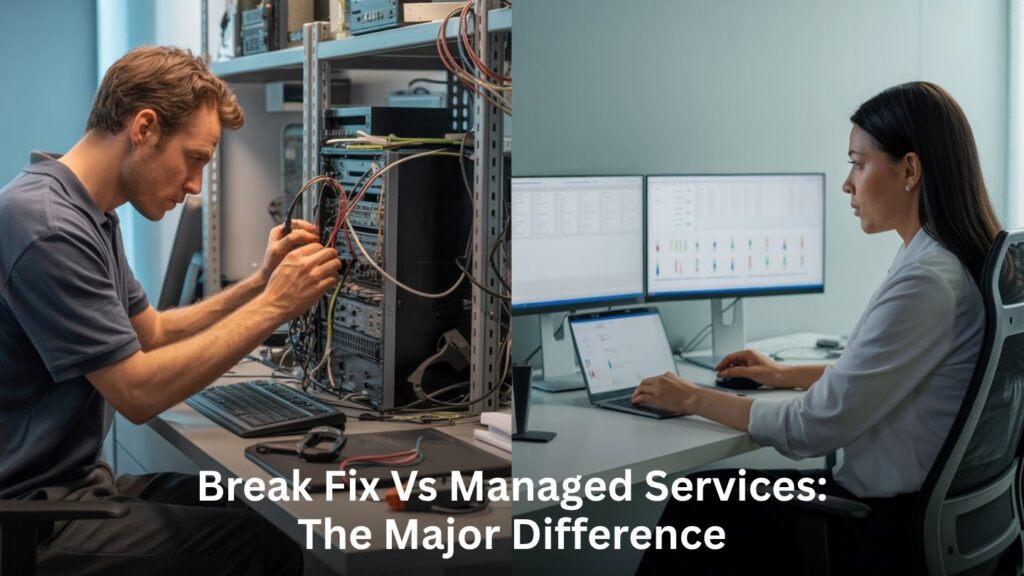
When your server crashes at 2 AM or ransomware locks your files, the IT support model you’ve chosen determines whether you recover in minutes or days. The difference between break-fix and managed services comes down to one key question: do you want to fix problems after they disrupt your business, or prevent them before they happen?
This blog reveals the core distinctions between reactive break-fix support and proactive managed services, helping you understand how each approach affects your costs, security, and long-term business operations.
Key Takeaways
- Break-fix is reactive support that waits for problems, while managed services prevent issues proactively through ongoing monitoring
- Managed services offer predictable monthly costs versus unpredictable expenses with break-fix
- Break-fix lacks continuous monitoring; managed services provide 24/7 system oversight with guaranteed response times
- Managed services include strategic planning and IT alignment, while break-fix focuses only on immediate fixes
- The choice directly impacts business continuity, security posture, and long-term growth potential
What is Break-Fix IT Support
Break-fix represents a reactive service model where businesses only engage IT service providers when something fails. Also called “pay-per-incident” or “time-and-materials” support, this approach means you pay nothing until a problem occurs, then you call for help and receive a bill based on labor hours and parts used.
Many small businesses and very small businesses choose the break-fix model because it appears cheaper upfront. There are no ongoing fees, no long-term contracts, and no monthly commitments. You maintain complete operational control over when and how you spend on IT.
Common break-fix scenarios include:
- Server crashes, bringing critical systems offline
- Software corruption or application failures
- Ransomware and virus infections, along with other common cybersecurity threats
- Hardware component failures, like failing hard drives
- Network equipment outages
- Backup system failures discovered only after data loss
How Break-Fix Works in Practice
The typical break-fix engagement follows a predictable pattern: a problem occurs, you report it to your IT providers, they troubleshoot and travel if necessary, resolve the issue, and then invoice you.
Billing structures under break-fix services vary, but typically include:
- Hourly labor rates with minimum charges (often two hours regardless of resolution time)
- Parts and hardware costs at markup
- Emergency or after-hours premiums
- Travel fees for onsite visits
The limitations of this support model become apparent quickly. There are no service level agreements defining response times. Your service call might be answered in minutes or hours, depending on technician availability. There’s no preventive maintenance, no proactive monitoring, and no guarantee of support availability outside business hours.
Perhaps most critically, break-fix creates accumulating technical debt. Without ongoing maintenance, systems fall behind on patches, software becomes outdated, and security vulnerabilities multiply, each one a potential trigger for the next expensive emergency.
What are Managed IT Services

Managed IT services represent a fundamentally different philosophy. Under a managed services model, a provider assumes ongoing responsibility for your IT infrastructure’s performance, security, and health. You pay a fixed monthly fee or flat monthly rate, and your managed service providers handle continuous monitoring, proactive maintenance, and strategic IT alignment.
The scope of managed services typically includes:
- 24/7 remote monitoring and alerting through remote management tools
- Patch management and software updates
- Endpoint security and threat detection
- Helpdesk support and user assistance
- Data backup and disaster recovery
- Vendor management and coordination
- Strategic planning and technology roadmaps
- Compliance and regulatory support
Service level agreements define the relationship clearly. Your provider commits to guaranteed response times, uptime targets, escalation paths, and defined availability, often with credits or penalties if they fall short. This accountability transforms IT from an unpredictable expense into a strategic partnership.
Common Mistakes to Avoid
Many businesses dismiss managed services based on misconceptions. Here are the most common mistakes to avoid:
- Fearing loss of control or vendor lock-in: Quality managed services agreements include regular reviews, customization options, and clear exit strategies. Many businesses maintain an internal team or use co-managed models to retain oversight.
- Believing it’s only for large enterprises: Data shows approximately 64% of companies now choose managed service providers over break-fix. Many small businesses and modern businesses adopt managed services precisely because they lack internal IT expertise and need budget predictability.
The Major Differences Between Break-Fix and Managed Services
Understanding fix vs managed services requires examining several dimensions where these models diverge completely.
| Factor | Break-Fix | Managed Services |
| Cost Structure | Variable costs per incident | Predictable monthly fees |
| Response Philosophy | Reactive support after failure | Proactive support prevents problems |
| Monitoring | None | Continuous monitoring 24/7 |
| SLAs | None or informal | Formal service level agreements |
| Planning | None, focused on immediate fixes | Strategic alignment with business goals |
| Relationship | Transactional service call | Ongoing partnership |
| Scalability | Ad HOC struggles with growth | Built for scale and adaptation |
Reactive vs. Proactive Philosophies
The break-fix model waits for failure. Your systems run until something breaks, then you scramble to find help. Response times depend entirely on technician availability, and you have no visibility into emerging problems.
Managed services take the opposite approach. Proactive monitoring through remote management tools detects 85% of issues before users even notice problems. Average response times under managed model agreements often fall below 15 minutes. Your IT systems continuously receive patches, updates, and optimizations, preventing the failures that trigger expensive emergency fixes.
Read more: Reactive and Proactive IT Support—Different Roles in IT Services
Service Scope and Strategic Value
Break-fix services address only the immediate problem. Once your server runs again, the engagement ends. There’s no data protection strategy, no disaster recovery planning, and no alignment between your IT infrastructure and business operations.
Managed services create value beyond fixing what breaks. Your service provider becomes a strategic partner offering, especially for businesses that want to outsource IT operations for faster, more secure support:
- Technology roadmaps aligned with business goals
- Compliance support and improved security
- Asset lifecycle management and optimization
- Vendor coordination and cost-effective procurement
- Strategic guidance for growth initiatives
Business Continuity Impact
Downtime under break-fix depends entirely on when you can reach someone and how quickly they can respond. With ransomware attacks costing SMBs an average of $126,000 per incident in downtime alone, the reactive service approach creates substantial business continuity risk.
Managed services build resilience into your operations. Data backup runs automatically. Disaster recovery plans exist before you need them. Your systems continuously receive security patches. When most businesses face outages, those with proactive support recover faster, often before operations are disrupted significantly.
Making the Right IT Support Choice

Choosing between break-fix and managed services ultimately comes down to how you value reliability, cost predictability, and long-term efficiency. While break-fix may seem convenient in the short term, managed services provide proactive support, reducing downtime and helping businesses stay focused, secure, and prepared for growth in an increasingly technology-driven environment.
JETT Business Technology delivers dependable IT service in Atlanta designed to keep your operations running smoothly and securely. Our expertise also extends to security, low voltage, and premise security services, ensuring complete protection and infrastructure support. Contact us to partner with us to strengthen your technology, minimize disruptions, and move your business forward with confidence.
Frequently Asked Questions
What is the main difference between break-fix and managed services?
Break-fix is reactive support; you pay only when something breaks, with no ongoing monitoring or prevention. Managed services provide proactive support through continuous monitoring, preventive maintenance, and strategic planning under a fixed monthly fee. The core distinction is waiting for problems versus preventing them.
When should a business choose managed services over break-fix?
Businesses should consider managed services when IT downtime significantly impacts revenue, when they lack internal IT expertise, when facing regulatory compliance requirements, or when planning for growth. Most businesses with more than 10 employees and any reliance on technology benefit from the managed model.
Can managed services prevent all IT problems?
No support model prevents every issue. However, managed service providers detect and resolve approximately 85% of problems before they affect users. Proactive monitoring, patch management, and ongoing maintenance dramatically reduce incidents, but hardware can still fail, and new threats constantly emerge.
How quickly can a business transition from break-fix to managed services?
Typical transitions take 15-30 days for smaller operations. The process includes system audits, infrastructure documentation, installing monitoring tools, defining service level agreements, and sometimes replacing outdated hardware. During transition, your new provider coordinates with existing IT providers to ensure continuity.
Do managed services include break-fix support when needed?
Yes. Managed services agreements encompass both proactive maintenance and reactive support when unexpected issues occur. The difference is that reactive fixes are included in your flat monthly fee, response times are guaranteed through SLAs, and your provider has full visibility into your systems for faster resolution.